M&A has always involved uncertainty. But the nature of that uncertainty has shifted.
Companies are built, financed, and operated in ways that weren’t possible ten years ago. Value now resides in data flows, embedded integrations, and tacit workflows rather than standalone assets. High-growth and founder-led businesses often scale ahead of their finance function. Multi-class equity, minority protections, and offshore holding structures create governance ambiguity where there wasn’t any before. Regulatory regimes reach deeper into operations. Stakeholder behavior is harder to read.
The result is that now a smaller portion of every transaction, somewhere in the 20-30% range, carries disproportionate M&A execution risk. It’s the non-standard, judgment-heavy work where assumptions break, feasibility is tested, and standard playbooks offer little guidance.
When capital is abundant, execution capability becomes the differentiator. The ability to identify, price, and manage non-repeatable complexity better and faster than the next bidder.
M&A complexity is not defined by deal type
In M&A, the term “complexity” is used a lot. But mainly to label deal types: carve-outs, cross-border transactions, regulated-industry deals. However they don’t tell you where the execution risk lives. They describe the setting but not the underlying forces that make a deal difficult to execute.
Complexity is defined by the conditions under which the standard playbook stops working: ambiguity, information gaps, stakeholder behavior, operational entanglement, regulatory constraints. Experienced operators recognize these when they show up. They usually look like slipping timelines, unstable assumptions or unexpected behavior.
But because complexity often appears buried inside other workstreams, it’s rarely treated as a distinct execution concern with its own structure or early warning signals.
The five dimensions where execution risk concentrates
Execution complexity enters transactions through a small number of recurring fault lines. These are not deal categories. Think of them as diagnostic lenses for a live transaction.
- Information uncertainty begins when clean, decision-grade data isn’t available or isn’t credible. Shifting historicals, KPIs that change definition over time, diligence workstreams that grow broader without increasing conviction. When this is misdiagnosed as a volume problem rather than a quality problem, diligence effort increases while confidence declines. Valuation becomes unstable, and integration planning is forced onto assumptions that haven’t been pressure-tested.
- Governance ambiguity surfaces when ownership, control, and economic exposure don’t align. Layered entity structures, minority rights that constrain decision-making, assets or IP held outside the operating entity. It rarely breaks a deal outright, but it constrains feasibility, limits strategic optionality, complicates integration, and forces structural or valuation changes late in the process when flexibility is lowest.
- Stakeholder dynamics are where some of the most consequential execution risk lives. Founders deeply embedded in operations. Misalignment between stated incentives and observed behavior. Internal buyer stakeholders pushing competing priorities. When misread, these introduce volatility into negotiations, slow execution, and undermine post-close continuity in ways that no amount of process can fully correct.
- Operational and technical non-separability comes into play when a business can’t be carved out or integrated the way the model assumes. Undocumented workflows tied to individuals, legacy system dependencies, bespoke customer configurations, data localization constraints. Left unidentified, this erodes synergies, delays value capture, and can force material re-scoping after signing.
- Regulatory non-standardness becomes execution complexity when it reshapes what’s feasible, not just what’s required. Jurisdiction-specific data rules, foreign investment review triggers, sector-specific licensing constraints, unclear regulatory precedent. When treated as a check-the-box exercise rather than a feasibility constraint, it surfaces late when options are limited.
How strong deal teams handle M&A Execution Complexity
Successful acquirers manage execution complexity with intention rather than trying to eliminate it. A few habits show up in the teams that handle this well.
1. They raise it early, as a genuine conversation rather than a box to check.
Where might the standard approach fail? Which assumptions are fragile? What would force a reprice, restructure, or delay? When complexity is treated as diagnosable risk rather than background noise, late-stage surprises drop.
2. They separate repeatable work from judgment-heavy work early.
Modeling, checklist-driven diligence, governance processes can be standardized. Execution risk lives in the smaller slice that can’t. When that line isn’t drawn, volume increases and the highest-impact risks become easier to miss.
3. They resist over-engineering.
In complex deals, the temptation is to manage uncertainty by adding structure: more earn-out metrics, more contingencies, more protections. But over-engineered deal structures tend to mask uncertainty rather than resolve it. Complexity shrinks faster by removing structure, not adding it.
4. They prioritize by feasibility, not financial magnitude.
Small, non-repeatable risks tied to governance, regulation, data, or human behavior can determine whether a deal closes or integrates regardless of their size on paper.
5. They bring integration thinking upstream.
Integration challenges trace back to assumptions made during diligence, structuring, and valuation, not failures of effort after signing. Teams that succeed bring operational leaders in before LOI.
Read the full whitepaper
The whitepaper goes deeper into each of these dimensions, with a diagnostic framework for identifying where execution risk is concentrated in a live transaction, and a set of principles that explain why some acquirers consistently execute better than others. Here’s what’s inside:
- The full definition of execution complexity and why deal type is the wrong lens
- All five dimensions, with early warning signals and downstream consequences for each
- How strong deal teams separate repeatable work from judgment-heavy work
- Six principles for pricing, resourcing, and managing non-repeatable risk
- BONUS: Four buy-side case studies across cross-border tech, PE roll-ups, post-close workforce disruption, and JV governance
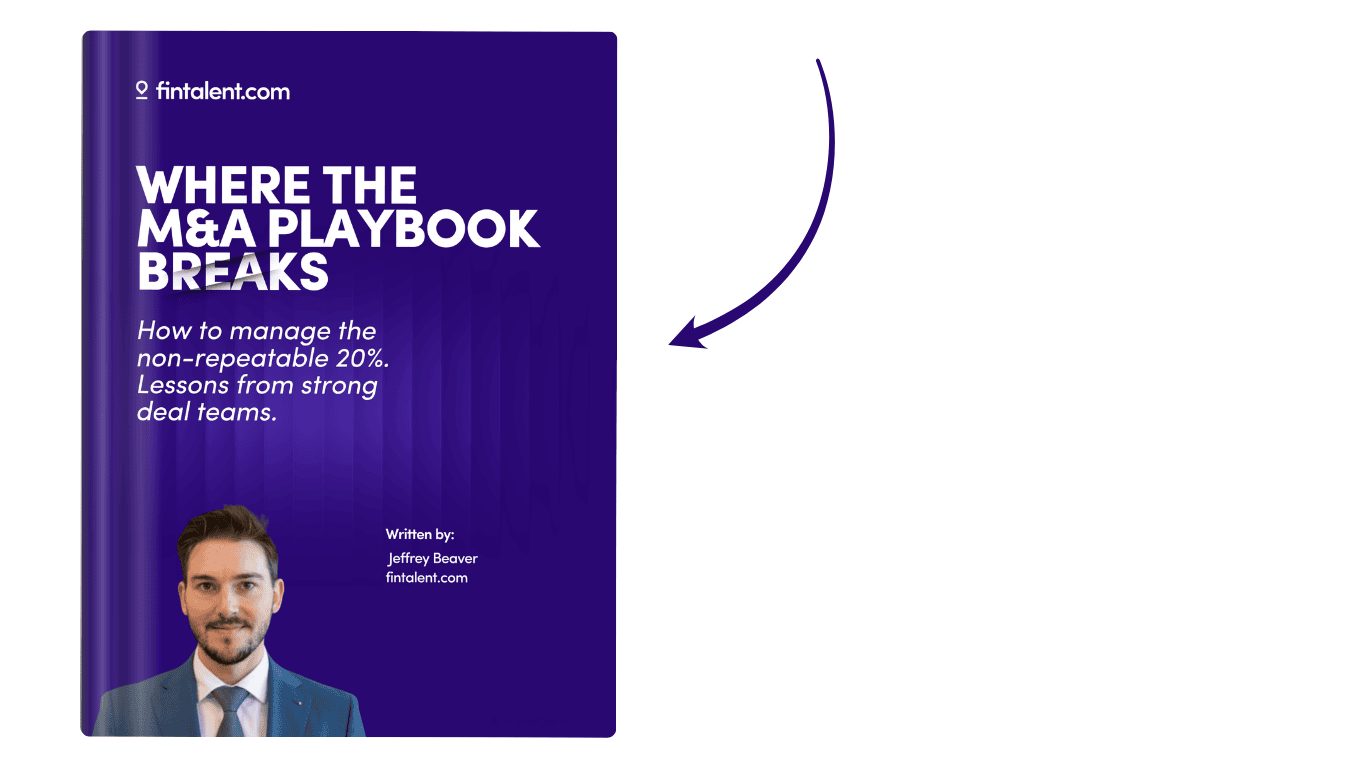
Get your copy of the “Where the playbook breaks” guide: